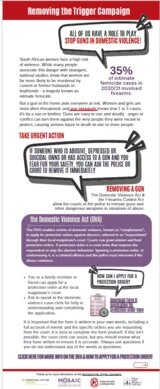
These publications - two case study flyers and a practical guideline - offer essential information on guns in domestic violence, including how to request the removal of firearms from abusive partners. They explain how the Domestic Violence Act and Firearms Control Act allow police or courts to act when someone abusive, depressed, or suicidal has access to a gun. The guideline also provides support resources, helplines, and safety planning tools.
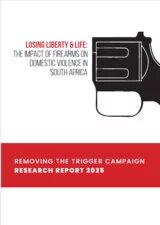
This research report explores the role of firearms in domestic violence. It draws on research to inform policy, improve practice, and enhance protection for women, children, and families affected by abuse. It is associated with the 'Removing the Trigger' campaign, a collaborative project of GFSA, MOSAIC, NSMSA, and the HBF.
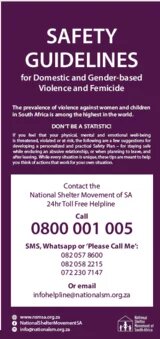
Download the Safety Plan for staying safe while enduring an abusive relationship, or when planning to leave, and after leaving. While every situation is unique, these tips are meant to help you think of actions that work for your own situation.
South Africa is in the grip of a femicide crisis, with firearms playing a leading role in the murder of women. This brief, developed by our partner, Gun Free South Africa, outlines six key recommendations to strengthen gun control, close legal loopholes, and prevent firearms from falling into the hands of those who pose a threat to women’s safety.
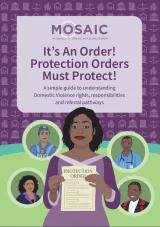
The Its An Order guidebook is a three-part guide developed by MOSAIC aimed at providing practical information to victims of domestic violence and first responders to domestic violence incidences and reports about rights, responsibilities and the law.
This brief is the second in a series produced by the Heinrich Böll Foundation in relation to its ‘Care and Support in a Time of Epidemic’ research project. The project focuses on the impact of the COVID-19 lockdown on shelter services to victims of domestic violence in South Africa, and seeks to strengthen policy and practice in the provision of domestic violence services.
The Hate Crimes Working Group has submitted written comments to Parliament's Portfolio Committee on Justice and Correctional Services, on the long-awaited Prevention and Combating of Hate Crimes and Hate Speech Bill.
A submission by two of our partners to the Committee on the Elimination of Discrimination against Women (CEDAW) in preparing for the review of the implementation of CEDAW by South Africa during the 80th Session (2021).
This brief is one of a series produced by the Heinrich Böll Foundation in relation to its ‘Care and Support in a Time of Epidemic’ research project. The project focuses on the impact of the COVID-19 lockdown on shelter services to victims of domestic violence in South Africa, and seeks to strengthen policy and practice in the provision of domestic violence services.
The long, hard road towards the recognition of rural land rights in South Africa has been burdened by our country’s history, now exacerbated by new laws that threaten rural democracy and threaten to dissolve spaces in which rural women can assert their rights and address challenges they face. This publication features the stories of four such women and their experiences of fighting against inequality and for citizen's land rights in South Africa.