

Reflection
Rising food prices, gender-based violence, biodiversity loss and loneliness rarely arrive one at a time. For women in communities like Cape Town’s Cape Flats, they collide every day, at the kitchen table and in the queue for food. At the Feminist Imaginaries Festival in Berlin, we set out to make these connections something people could taste and not only discuss. Over four courses, we asked: who sets the table, who goes without, and who has the power to change the system?

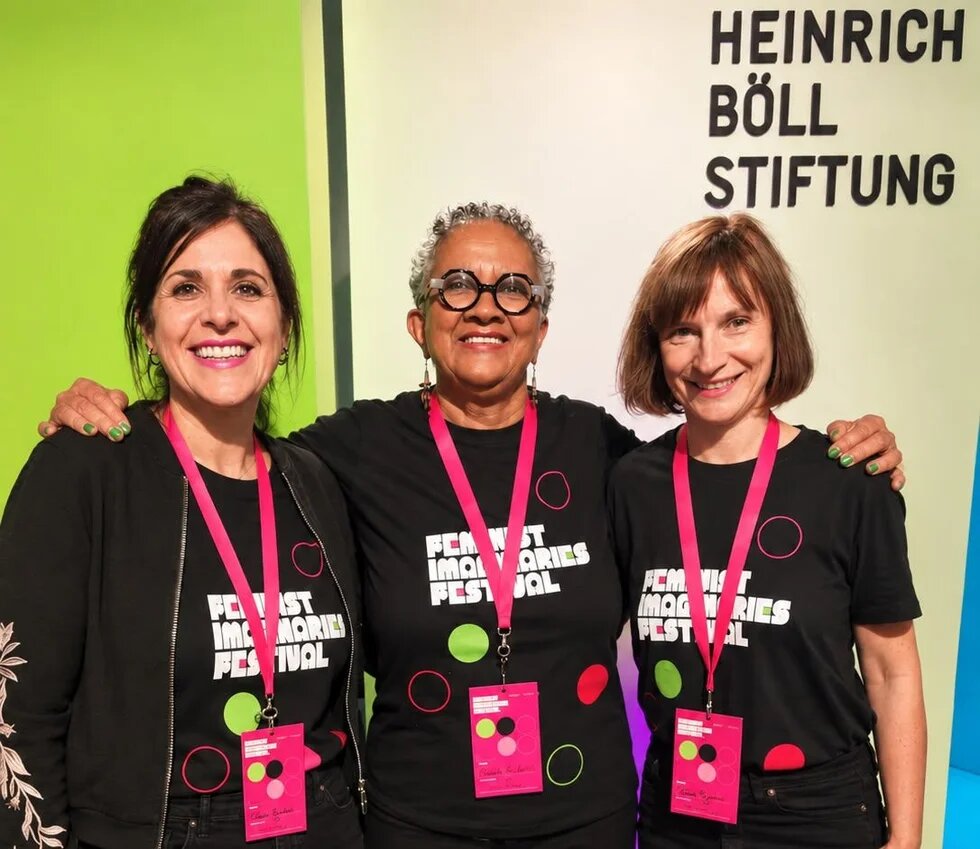
In September 2026, three co-conspirators – Claudia, Caroline and Nicole, two South Africans and a Berliner – hosted a workshop at the Feminist Imaginaries Festival in Berlin, organised by the Heinrich Böll Foundation’s Global Unit for Feminism and Gender Democracy together with the Gunda Werner Institute. We work together on a collaborative project, Strengthening GBV Responses through Food Security Systems, from our respective bases at the Heinrich Böll Foundation’s Cape Town office, the community-based Callas Foundation and WEAVE Strategies. We called our session “A Polycrisis ‘Afternoon Tea’: Conversations on Food, Crisis and Care”. In the spirit of the festival’s call to imagine, we skipped presentations and panel discussions altogether. Instead, we served food, one dish at a time, with each meal opening a new, but interconnected, conversation.
The polycrisis is not an abstract idea
Polycrisis is a big word. Everyone nods, but how many of us truly understand it? For Caroline, who comes from the Cape Flats in Cape Town, South Africa, the polycrisis is not just an academic concept of the kind Nicole often discusses in conference rooms. It is the reality that women, children and families wake up to every single day in a community created by apartheid and still marked by deep inequality, deprivation and gang violence. Caroline's team at the Callas Foundation has run a community kitchen there since 2018, and they see first-hand how hunger, poverty, gender-based violence, unemployment and inequality are bound together. Every day, women (especially) stand in queues for food – not because they have failed to provide for their families, but because the systems meant to protect and support them have failed them.
That gap between concept and lived reality shaped our approach. We wanted people not only to think about these issues, but to feel them: to taste, smell and touch them, through every sense possible. And what better way to do that than through food? Food may mean different things to different people, but everyone can relate to it, whatever their profession, country or language.
A meal is never just a meal
Food carries many meanings at once. Scientifically, it is nutrition: a combination of proteins, carbohydrates, fats, vitamins and minerals that keeps the human body alive. Economically, a meal is a commodity. It has a price. It has been produced, processed, transported, traded and sold. Ecologically, it begins as a seed, planted in soil, watered and fed. Politically, it is a distribution of resources. Someone owns the land. Someone sets the price. Someone earns a wage. Someone does not.
And from a feminist perspective, a meal is also care. Someone thought about what we would eat. Someone grew it. Someone bought it. Someone cooked it. Someone laid the table. Someone dished up. And later, someone will clean up.
But a meal is more than all of this. We eat when we celebrate. We bring food when somebody is grieving. We cook for people when they are ill. We invite someone to our table to say: you belong here. Food is intimate, and it is political.
Each of us also carries our own connection to food. It might bring back nostalgic memories of sitting at your grandmother's kitchen table, or of lunch breaks with friends at school – or the anxiety of staring into an empty kitchen cupboard. At the festival, food became more than something we shared. It became a way into conversations about power, privilege, inequality, survival and care.
Polycrises on the menu
We chose four crises that shape our work and our lives: rising prices, the loss of biodiversity, gender-based violence and loneliness. Here we share two of the courses.
We began with a chickpea flour tart to represent rising food prices. Chickpea flour is relatively affordable, filling and nourishing, yet it is not widely accessible – and in that sense it remains something of a privilege. When food prices rise faster than incomes, households do not simply buy the same food at a higher price. They change what they eat. Diets become less varied, expensive proteins and fresh foods are replaced with cheaper alternatives, portions shrink and some meals disappear altogether. And these adjustments are gendered.
Women still carry a disproportionate share of food provisioning and unpaid care work. So when the household food budget no longer stretches, the economic shock is partly converted into women’s time, labour, anxiety and risk: searching for cheaper food, travelling further, substituting ingredients, stretching meals, deciding who gets what, borrowing and, in the most desperate moments, taking food they cannot pay for.
We have seen the consequences of the rise of food insecurity very concretely in Cape Town. In 2023, as the cost of the household food basket began its first sharp rise, the staples eaten mainly by low-income households were hit especially hard. At the same time, community kitchens reported longer queues and fewer donations. Some of the women running kitchens, though struggling to make ends meet themselves, even used their own social grants to keep feeding others.
Rising food prices are therefore not only an economic question; they are a feminist one. Who absorbs the shock when food becomes unaffordable? Hunger is not just about an empty stomach. It raises questions of dignity, power, choice and access, and of who carries the heaviest burden when the cupboards are bare. And when a woman who depends financially on an abusive partner cannot feed her children, food insecurity becomes part of the cycle of violence.
That link brought us to our next dish: devilled eggs, a symbol of fertility and fragility, but also of gender-based violence. Claudia reminded us of the old saying about "walking on eggshells" to avoid angering an easily provoked, abusive man.
Gender-based violence is not a side effect of crisis; it is rooted in unequal power. But crises can intensify the conditions that enable it. Economic shocks can deepen financial dependency. Housing insecurity can make leaving harder. Displacement can break down support networks. Cuts to funding can reduce access to shelters, counselling and legal support. Health crises, too, can shift conditions suddenly.
Nowhere was this clearer than during COVID-19, when lockdowns made these intersections brutally visible. For some women, the home they were confined to for their safety became the very place where they were least safe. In households where food insecurity was already causing tension, the situation became unbearable.
Yet COVID-19 also created new ways of being, thinking and doing. In Cape Town, community kitchens became the unsung heroes of the crisis: not merely places to get a meal, but much more. Since then, through the work of the Callas Foundation, the Alcardo Andrews Foundation, Gogo’s Kitchen, Ubuntu Rural, Uphakanini Community Kitchen and many others, community kitchens have grown into safe spaces where women can find one another and share their stories. Sometimes a community kitchen is where violence is disclosed for the first time. And it is here, too, that solidarity and collective action take root: through sharing information, offering legal support and opening pathways to emergency help, shelter and counselling.
In Cape Town these kitchens become more than just a place to eat; they are places of organization, care and support. This idea stayed with us as the afternoon moved through our last two courses, on the loss of biodiversity and on loneliness. The conversations around our own table grew deeper as people shared their experiences and insights on problems, solutions and strategies alike. These ranged from pooling resources when times are tough, to building community over bowls of soup, to the work of women in the informal economy making salt in traditional salt-making communities in India, and much more.
Leaving the table
As we rose from the polycrisis table that day, having shared food and conversation with people from different countries and contexts, one thing was clear: while our circumstances differ, our individual and collective struggles are connected. Four dishes opened the door to four crises, but they also reminded us that solutions cannot exist in isolation. Four problems do not require four separate policies. People’s lives don’t work like government departments. A woman does not experience food inflation on Monday, biodiversity loss on Tuesday, gender-based violence on Wednesday and loneliness on Thursday.
Through the conversation that day we talked about food as survival, as care, as knowledge, as community – we talked about what happens when crises begin to overlap in people's lives, the impacts of inequality, drought and hunger and so much more. We did not walk away with groundbreaking solutions to these complex problems. But we did walk away knowing that we need to connect our struggles, our movements and our collective demands for justice and how important it is to ask deeper questions, and to look at how these struggles are interconnected through a feminist lens. Ultimately, the question is not only what we put on the table, but who has a seat at it, who prepared the food, who goes without, and who has the power to change the system.
Those questions lead to others. When mothers skip meals so that their children can eat, we need to ask why women's sacrifices have become so normal. When communities are expected to feed themselves through charity while structural inequality goes unchecked, we must ask whose responsibility it really is to make sure nobody goes hungry. We need to move beyond conversations about care to conversations about justice.
We cannot keep celebrating women's resilience without asking why they are constantly forced to be resilient. And we cannot keep asking women to carry communities through crisis while the systems that create those crises remain unchanged. Things need to change.
As we closed the door on our workshop, we left enriched and inspired by the stories shared, the ideas generated and a common realisation: imagining feminist futures means imagining a world where no woman has to choose between her safety and feeding her children, where care is valued and shared, and where access to nutritious food is recognised as a fundamental human right rather than an act of charity.
And now, dear reader, we leave you with a question: what thoughts, hopes and possibilities are you carrying with you as you imagine a brighter feminist future?