This publication examines why existing mine closure and rehabilitation efforts have fallen short, and what this means for achieving a truly just transition.
In early 2025, police announced that operation ‘Vala Mgodi’ (Close the Holes) had been completed at the Buffelsfontein gold mine near Stilfontein. It is estimated that approximately 100 ‘illegal’ miners died as a result of the operation. This paper explores the background conditions and policy context which led to this avoidable tragedy, and makes recommendations as to how artisanal and small scale mining should be addressed in future.
Despite Africa’s exceptional solar and wind resources, and the exhibiting costs, lead time and risks of nuclear power, announcements of nuclear power plant projects and cooperation agreements proliferate across the continent. This report was commissioned to try to distinguish hype from reality and provide a realistic assessment of which African countries’ nuclear plans are likely to materialise in the coming two decades.
The past few years have seen significant excitement about the role 'Green' hydrogen could play in decarbonising economies. More recently, interest in geogenic or 'white' hydrogen - naturally occurring hydrogen found in geological formations. This publication provides an overview of the current state of knowledge on geogenic hydrogen and its potential role.
The policy brief introduces basic concepts around the complexities of steelmaking, including why it has historically been seen as ‘hard to abate’ in terms of reducing the greenhouse gas emissions from steel production. It aims to provide a non-technical commentary on AMSA’s Decarbonisation Roadmap suitable for frontline communities and the NGOs they work with to understand and engage with the plans.
Over the past decades, significant safety improvements have been made to nuclear plants as lessons from nuclear accidents have been integrated into reactor design. These are so significant that, France now considers older plants - identical to SA's Koeberg - to be unsafe. Consequently, in extending the life of these plants, France is undertaking significant safety improvements. As public hearings into the life extension of Koeberg get underway, we ask: how do France's upgrades compare to those being implemented by Koeberg?
In July 2022, Eskom submitted a Safety Case Report (SCR) on the Koberg Nuclear Power Station to South Africa’s National Nuclear Regulator (NNR), as part of the efforts to extend Koberg’s lifetime. Unfortunately, Eskom refused to make the SCR public, despite its significance to public interest. In January 2023, a heavily redacted version was released to the public, and in June 2023, following court action, the report was released in full. This publication compares the various versions of the SCR with the intention of highlighting what information Eskom sought to conceal.
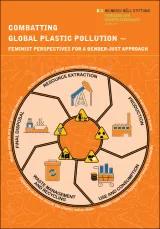
A critical look at the entire plastics cycle is also of crucial importance from a feminist perspective, because the plastic problem cannot simply be reduced to consumer use patterns or to harmful microplastics in cosmetic products. On the contrary, every stage of the plastics cycle reflects different gender-specific experiences and exposures.
Increasingly, green hydrogen features prominently in the decarbonisation plans being adopted around the world. Given excellent wind and sun resources, much of it will be produced in global south countries, and exported to global north countries. Countries in the Southern African region are taking notice, and positioning themselves to benefit from these potentially lucrative future markets, by making significant infrastructure investments. But what is green hydrogen? Will investing in it really create jobs and wealth? This booklet presents accessible information regarding the promises, risks and impacts green hydrogen could have for communities in South Africa. It was developed as part of HBF CT’s work to uphold host communities’ right to Free Prior and Informed Consent, and support civil society capacity to engage in hydrogen related policy.
The latest report of the IPCC regarding Climate Change Impacts, Adaptation and Vulnerability confirms that climate change is already causing severe and permanent loss and damage to human and natural systems
A continuing insistence on nuclear will be detrimental to our ability to power a Just Transition: while the jobs it creates are few and primarily for the highly skilled, its enormous costs will likely result in austerity policies.
During the COVID-19 lockdowns of 2020, a group of community researchers, together with students, undertook a study on hunger and agency in the food systems of five locations.
Hunger and malnutrition are not accidental by-products of our food systems. This publication aims to present the causes of hunger and malnutrition, and show that clear political rules and strategies are needed to counter these realities.
Illicit political party funding poses significant threats to democracies worldwide. But to what extent do the fundraising practices of Zimbabwe’s political parties also threaten ecological and environmental justice? This research by the Centre of Natural Resource Governance assesses parties’ practice of selling mineral rights in the context of Zimbabwe’s 2018, 2013 and 2008 elections.
This briefing draws on a combination of interviews and participatory mapping events in Walkerville, Orange Farm and the West Rand regions of Gauteng and uMgungungdlovu District in KwaZulu-Natal (KZN) between August and November 2020. It highlights findings and recommendations from a short-term project to source fresh produce from smallholder farmers for food relief efforts in these areas as part of the emergency response to the Covid-19 pandemic and the lockdown.
This policy brief summarises key lessons from a project to connect small-scale farmers with food relief efforts as an immediate response to the negative impacts of the Covid-19 pandemic on food security in resource-poor communities.
Although economic growth is a major driver of GHG emissions, there is still a great deal of skepticism that it is viable. A Societal Transformation Scenario for Staying Below 1.5°C sketches out paths for genuine socio-ecological transformation that leads to a better life while reducing consumption and production in the Global North.
How should policymakers respond to the reality and future prospect of vast populations being displaced and relocated in an era of global heating? With climate change looming, anxiety over immigration from the Global South is increasingly fuelled by apocalyptic fears of ecological breakdown.
This volume offers fresh perspectives on the relationship between climate change and human migration, questioning the pessimistic prisms of ‘security’ and market-oriented approaches to ‘adaptation’ that currently guide policy.
The Systematic Exclusion of the Kwazulu Natal Subsistence Fishers from the Fishing Rights Regime in South Africa. This Policy Brief is a summary of research report on the Exclusion of Subsistence Fishers in KwaZulu Natal from the fisheries policy regime.