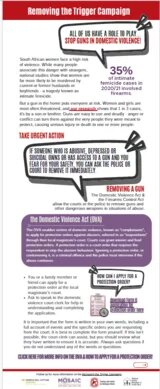
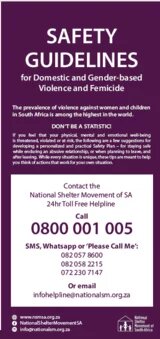
These publications - two case study flyers and a practical guideline - offer essential information on guns in domestic violence, including how to request the removal of firearms from abusive partners. They explain how the Domestic Violence Act and Firearms Control Act allow police or courts to act when someone abusive, depressed, or suicidal has access to a gun. The guideline also provides support resources, helplines, and safety planning tools.
Download the Safety Plan for staying safe while enduring an abusive relationship, or when planning to leave, and after leaving. While every situation is unique, these tips are meant to help you think of actions that work for your own situation.
This brief is the second in a series produced by the Heinrich Böll Foundation in relation to its ‘Care and Support in a Time of Epidemic’ research project. The project focuses on the impact of the COVID-19 lockdown on shelter services to victims of domestic violence in South Africa, and seeks to strengthen policy and practice in the provision of domestic violence services.
This brief is one of a series produced by the Heinrich Böll Foundation in relation to its ‘Care and Support in a Time of Epidemic’ research project. The project focuses on the impact of the COVID-19 lockdown on shelter services to victims of domestic violence in South Africa, and seeks to strengthen policy and practice in the provision of domestic violence services.
This brief is based on the findings of a study undertaken to understand women's experiences of shelter services and the factors that aided or hindered their long-term recovery from abuse; an aspect crucial to improving government and non-profit sector policy and practice.
While South Africa is in lockdown to curb the spread of the coronavirus, for those in abusive relationships, isolating at home presents additional risks. Our partner, the National Shelter Movement, has put together some suggestions for those needing to stay safe and seek help during this time.
This publication is the last in a series of provincial studies on shelters for abused women undertaken by the HBF and the NSM and supported by the EU. This study focuses on women's experiences of having accessed shelters and those who render such services. It does so in an attempt to better understand what is required to meet the long-term needs of those seeking reprieve and an end to violence.
This publication is one of a series of provincial studies on women's uses of shelters undertaken by the HBF and the National Shelter Movement of SA's EU-supported 'Enhancing State Responsiveness to GBV: Paying the True Costs' project. The publication describes women's uses of domestic violence shelters paying particular attention to women's mental health needs as well as government policy and budgets in relation to the provision of sheltering services in the Eastern Cape and Northern Cape.
In S v Baloyi the Constitutional Court placed a clear duty on the state to address domestic violence. Shelters disrupt this violence in significant ways but are significantly under-funded. This brief examines existing policy around shelters for abused women and recommends how this can be expanded and costed to more effectively uphold women’s rights and needs.
Shelters provide critical services to abused women, yet, most are chronically under-funded and highly variable. Current government allocations to shelters are not informed by a costing framework. This results in services being driven by resources rather than best practice. A new report aims to address that short-coming.
This publication is the first of a series of shadow reports that the Heinrich Böll Foundation and the National Shelter Movement of South Africa have produced in relation to their ‘Enhancing State Responsiveness to Gender Based Violence: Paying the True Costs’ project. The publication was partly produced with the Tshwaranang Legal Advocacy Centre to End Violence against Women.
This publication is the second of a series of shadow reports that the Heinrich Böll Foundation and the National Shelter Movement of South Africa have produced in relation to their ‘Enhancing State Responsiveness to Gender Based Violence: Paying the True Costs’ project. The publication was partly produced with the Tshwaranang Legal Advocacy Centre to End Violence against Women.This report was produced with the financial support of the European Union.
This policy brief considers the provision of shelter services to victims of domestic violence and is done in relation to the Heinrich Böll Foundation (HBF) and the National Shelter Movement of South Africa‘s (NSM) “Enhancing State Responsiveness to GBV: Paying the True Costs” project. Funded by the European Union, this project aims to support state accountability for adequate and effective provision of domestic violence survivor support programmes, specifically those associated with the provision of shelter for abused women.
This policy brief presents a summary of two shadow reports that focused on shelter policy, funding and practice and ends with a set of recommendations for the improvement of sheltering services for abused women and their children.
This shadow report assesses the provision and funding of shelters by the Western Cape Department of Social Development while considering whether shelters in this province have sufficient resources to meet the legitimate needs of women and children seeking refuge from domestic violence in the home.